A Blog to Keep the Lizards Away. It's about posting and sharing the things I'm into. Hope you enjoy the show!

Monday, 22 August 2011

Jimi Hendrix - Power, Passion, Fragile Genius

James Marshall Hendrix [1942 - 1970]

Jimi Hendrix was born November 27th, 1942, in Seattle, Washington, USA. The first of five children to James "Al" Hendrix. He was part Cherokee Indian and part Afro American. From humble beginnings and a $5 acoustic guitar when he was 15, Jimi Hendrix went on to become the greatest electric guitarist in musical history.


He grew up listening to BB King, Muddy Waters, Howlin Wolf, Albert King and Elmore James. His real rock influences came from listening to and playing behind Little Richard. Jimi always said he wanted to, "do with my guitar what Little Richard does with his voice."


" His official biography says: "Jimi Hendrix was one of the most creative and influential musicians of the 20th century. Innovative style of combining  fuzz, feedback and distortion top create a new musical style."

I believe this description sells Jimi short for it does not take into account his genius as a record producer and his use of the recording studio as an extension of his creative abilities. It does not acknowledge his engineering and manipulating of new sounds, that influenced musicians across a broad genre of music. Jimi was the only musician to be top of the Billboard Chart listings in Jazz, Rock and Blues, all at the same time.

I've been trying to think of another instance where one person completely mastered his instrument or excelled in displaying his talent to the degree Hendrix did. Superlatives do not do justice to the natural ease at which he seemed to demonstrate his art.

After a stint in the Army in 1961, he came back to play in the line-up for Ike and Tina Turner, Sam Cooke, the Isley Bros and Little Richard. In 1965, he moved to be part of the developing scene in Greenwich Village and whilst all the bands wanted Jimi behind them, he decided to take his trip to London to get noticed as a solo artist.

He formed the Jimi Hendrix Experience with drummer Mitch Mitchell and bassist Noel Redding. By 1966 he was the talk of the U.K. Every venue he appeared, night after night, some of the biggest rock stars in Britain would pack the Clubs to see what all the fuss was about.


One of the most iconic images in Rock and Roll. Jimi finishes his set at Monterey in 1967.

By the time Jimi went back to the States he was welcomed as a superstar. His first L.P. Are You Experienced was a huge successes but it was not until his incendiary performance at the Monterey Pop Festival that he became of the biggest acts in the world - overnight.

At the Monterey Pop Festival in 1967, the Who were booked to close the show, until Pete Townsend realised they had to follow Jimi. Townsend refused and after a stand-off, the promoters insisted Jimi go on last. The Who pulled out all stops, Townsend smashed his guitar, the band wrecked the stage set and the urban myth has it that when Townsend left the stage he said to Jimi, "Beat that ni**er!"

The rest his history. Jimi closed the show playing Wild Thing, poured lighter fluid on his Strat and set it alight. Still vibrating and screaming feedback, Jimi picked up the burning guitar, smashed it and stormed off.

Jimi's signature guitar was a right-handed, white Fender Stratocaster. He played left-handed so he turned the guitar upside down and re-arranged the strings. He also moved the tone and volume controls to the top of the guitar so he could access them easily. Later when he could have what he wanted he chose a black maple-neck and a blonde maple neck Strat.

And strangely for someone with such a good voice, Jimi was always very nervous about his singing. In the studio he recorded his vocals behind a screen

Jimi followed Are you Experienced with Axis Bold as Love in 1968. By 1969 the pressures of touring took their toll and the Experience disbanded.

After experimenting with a new line-up he changed the group's name to Band of Gypsy's. A self-titled compile album followed. And then the double album Electric Ladyland which he recorded in his own Electric Ladyland studios he built in New York.

Jimi plays the Woodstock 3 Day Festival in 1969

The Woodstock Music Festival was staged on a farm at Woodstock, Bethel, NY on August 17th, 1969. It was a fitting climax to the peace, love, dove era of the Sixties.

[After Woodstock, the peace came to a shuddering halt at Altamont, the next big outdoor festival. The headline act was the Rolling Stones who on stage when a fan was stabbed to death by Hells Angels security]

At Woodstock the best bands of the Sixties appeared, including Janis Joplin, Ten Years After, Ritchie Havens, Ravi Shankar, Arlo Guthrie, Joan Baez, Country Joe, Canned Heat, Grateful Dead, Credence Clearwater, Sly and the Family Stone, The Who, Jerrerson Airplane, Joe Cocker, Ten Years After, Crosby Stills Nash & Young. 40 years later Woodstock still belongs to Jimi Hendrix.

Hendrix assembled a group called Gypsy Suns and Rainbows including the original drummer Mitch Mitchell playing with bassist Billy Cox and guitarist Larry Lee, plus two other percussionists, Jerry Velez and Juma Sultan.

Jimi was booked to close the show but they ran so late that he ended up on stage at 7am on the Monday morning, playing to only a few thousand mud-soaked, die hard fans. Most had already left the night before to get home for the working week. They missed the performance of the decade. A performance that defined the Sixties.

Even though the band was worn out and wired, they played for nearly two hours, one of the longest sets of Jimi's career. The first time he ever played in the morning.

Jimi greeted them with, "You can leave if you want to ... we're just jammin', that's all."

Message to Love, Hear My Train A Comin', Red House, Mastermind, Lover Man, Foxy Lady, Jam Back at the House, Izabella, Gypsy Woman, Fire, Voodoo Chile, Star-Spangled Banner, Purple Haze, Improvised Villanova Junction and Hey Joe as an encore. The only time Jimi played an encore. [During Redhouse he broke a high E-string and played the rest of the song with 5 strings.]

His inspired, improvised performance of the Star-Spangled Banner anthem is the sound of Woodstock.


Watch the vision and the total control with which he creates his wall of sound. Sure there have been master technicians that can play the notes, but still nobody can match the exact sound, let alone create it from scratch.

Great photo - wrong album!

Despite the hundreds of bootleg, live and "lost tapes" versions that are available, during his lifetime, Jimi only ever released three studio albums, The Experience, Axis Bold As Love and Electric Ladyland. There were also two live albums and two compilations and twelve singles from those albums.

Since his death the "official" album releases were Cry of Love, War Heroes, Rainbow Bridge, Crash Landing, Midnight and the latest, Valley of Neptune. Whilst any Hendrix is better than none, I would not waste my time with the others. [If you need a fix just go back and listen to the long version of Voodoo Chile!]

Jimi with Buddy Miles

Jimi Hendrix died in his sleep, in his London flat, September 18, 1970. He was 29 years old.

The autopsy said he died of asphyxiation, choking on his own vomit, which had filled his airways. Earlier that night he attended a party with his friend Monica Dannemann. Getting home at about 3 am he reportedly took up to nine sleeping pills - the recommended dose was one and a half.

Apart from the pills there was not much else in his system, certainly no cocktail of drugs as was commonly thought at the time.

Unless you were there its hard to explain to people the impact his music, his sound, his easy, relaxed style of playing had on the scene as it was back then.

Even now it totally stands the test of time. Nobody has come close.

Wednesday, 17 August 2011

Downton Abbey - The Real Story Is Much Stranger Than Fiction

Almina, Countess of Carnarvon and Chaterlaine of Highclere Castle

Like many millions of others around the world, I was recently swept up in the Downton Abbey television series, although I must admit I was more interested in the setting than the storyline. The real star of the series is surely the magnificent Highclere Castle and the wonderful protocol that was strictly followed by the resident family and their guests of that early 1900's era. Namely George Herbert, the 5th Earl of Carnarvon and his wife Almina, the Countess of Carnarvon. And it is their true life story that is fascinatingly colourful, if not scandalous - much more so than the story portrayed in the television series on which these characters lives are based.

Highclere Castle in Hampshire, setting for the Downton Abbey TV Series

Even Almina's parentage is a source of controversy. When she was born in London in 1876, her French mother, Marie, was already separated from her husband, Fredrick Wombwell and Almina was thought to be the result of a liasion with Alfred de Rothschild - of the Rothschild banking dynasty and one of the world's richest men. Whatever was the truth, Alfred took a fatherly interest in Almina and thanks to his financial support, when Almina was presented at Court at age 17, it was not only her looks but also her wealth that made her an attractive proposition to aristocratic young men looking to prop up their family fortunes.

Lord Carnarvon, no doubt, had the upkeep of Highclere Castle in mind when he proposed to Almina, as well as his massive gambling debts.

George Herbert, the 5th Earl of Carnarvon

Together with his Eton schoolfriend and Indian prince Victor Suleep Singh, a notorious playboy, George toured the fleshpots and gambling dens of Cairo, Hong Kong and Paris. By the time he met Almina at a Buckingham Palace state ball, George was suffering from the ravages of his exploits, looking very much the dissolute aristocrat.

Prince Victor Duleep Singh, Lord Carnarvon's Eton schoolfriend.

Alfred de Rothschild was keen for Almina to marry into peerage so he agreed to pay off the Earl's gambling debts, which amounted to an incredible 150,000 pounds, in return for her hand. Sensing a money stream, George also asked for a staggering 500,000 pound dowry, about 50 million dollars in today's money!

The unlikely pair were married in June 1895, the Earl towering above Almina who was only 5 feet tall. After an expensive honeymoon, Almina soon settled into Highclere Castle, spending millions on refurbishing the run-down state rooms and hosting lavish parties for up to 500 guests.

The Library at Highclere Castle

In 1895 alone the Countess spent $360,000, in today's currency, on chefs, wine and flowers to prove to her new husband she could "run the house."

Highclere Castle's Salon

Almina was nicknamed "the pocket rocket" such was the vigour and energy she displayed in playing the society hostess at Highclere, interspersed with her regular appearances in London wearing fabulous "royal" gowns, dripping with precious diamonds and pearls.

Countess Almina's diamond Carnarvon Tiara

Whilst Almina was entertaining, her husband, the Earl soon tired of this scene and took up reckless, high-speed motoring which ended in a spectacular crash whilst racing in Gemany. The Earl was trapped under his overturned car with a broken jaw and punctured lungs. Almina nursed him back to health at Highclere but the Earl was now a semi-invalid, relying on a stick to walk and suffering from debilitating migranes. They had two children together, a son and heir to Highclere, Henry, the 6th Earl of Carnarvon and a daughter Evelyn.

Countess Almina and Lord Carnarvon - A Day at the Ascot Races

The Earl developed another passion - aviation. So did Almina. Hurt and frustrated, in true Lady Chatterley style, she required the regular services of one of Highclere's gardeners. Fortunately the Earl's doctor recommended he spend the damp winter months in a drier climate, so he decided to exercise his interest in egyptology. Travelling to Luxor he soon sponsored local egyptologist Howard Carter's digging exploits, a famous partnership that resulted in the historic discovery of Tutankhamen's tomb.

Lord Carnarvon and his daughter Lady Evelyn are greeted by Howard Carter at Luxor Railway Station

During this time World War 1 had started and Britain's young men were coming home maimed and incapacitated. Almina converted Highclere Castle into a luxurious military hospital, recruiting teams of pretty nurses. The 200-room castle housed operating theatres, exquisite salons became casualty wards and the grounds saw teams of nurses pushing wheelchairs around. She established another hospital in London for the officers who needed to be near specialist doctors. During their long recuperations they were waited on by butlers and footmen.

Almina's generosity drained even her resources. On the edge of financial collapse and very conveniently, her benefactor Alfred de Rothschild died, his huge legacy saving her from bankruptcy. Temporarily.

The discovery of the boy pharaoh's tomb brought the Earl fame and recognition. He also died as a result. In 1923, whilst staying at the Winter Palace hotel in Luxor, the Earl was bitten by a mosquito. The bite became infected and he was rushed to Cairo. Almina hired a de Havilland biplane and flew to Cairo with one of Britain's best doctors but they could not save him. His death started the "curse of the pharaohs" cult.

Almina's mourning did not last long. That same year she married Colonel Ian Dennistoun, an army officer permanently wounded in the war. He died in 1938 and Almina took a lover 20 years her junior.
Her conduct was such that she was no longer welcome in high society and royal circles.

Her son Henry, the 6th Earl, inherited Highclere, but she ensured he did not receive any of the Rothschild money keeping it all to maintain her lifestyle. Henry was a renowned "womaniser" and with very little interest and income, the grand house soon succumbed to a lack of maintenance, with whole wings being closed and abandoned.

Almina continued to spend her fortune until in 1951 it was all but exhausted. Shunned from society she was forced to move to a modest terrace house in Bristol with only her housekeeper. After a full life of triumphs and scandals that makes the Downton Abbey scripts look very tame, she died in 1969, aged 93.

Its interesting to note that the famous composer/stage producer Andrew Lloyd Webber currently lives on an adjoining estate to Highclere Castle and he is reportedly upset about the increased traffic and fuss created by the Downton Abbey production. On the upside some of the funds generated as location fees will help to restore this magnificent castle for future generations.

Sunday, 14 August 2011

57 Chevy Dreams

1957 Chevrolet Bel Air

Like most people I have always admired Hot Rods and Custom Cars from afar but never really had the chance to get in one. That all changed when a friend of mine introduced me to his new toy. Now I'm really hooked. I guess I was expecting a beast that shaked, rattled and rolled. Lot's of excitement but very unpredictable to drive. I could not have been more wrong.

 Big Bore Block. 600hp. A slight improvement from the 283hp factory original.


Sure this beauty is incredibly powerful. It's also tight, stops on a dime and sits flat going around corners. I don't recommend you try this at home but there are an incredible array of kit parts available ex U.S. to turn the most meek and mild sedan into Mr Hyde. That is if you have the $$$ to spend. I can't tell you what happened when we let this Chevy out, but I promise it was worth every cent!

The 1957 Chev Bel Air is among the most recognisable American cars of all time.

Thursday, 4 August 2011

Native Americans the Only Heroes at Little Big Horn Battle

Graveyard on Last Stand Hill above Little Big Horn Flats

The battle of Little Big Horn, also known as Custer's Last Stand, was the most famous action of the Great Sioux War. On June 25th and 26th, 1876, the forces of the Lakota, Cheyenne and Arapaho peoples decimated the 7th Cavalry Regiment of the U.S. Army, near the Little Big Horn River in Eastern Montana.

Led by Chief Crazy Horse, 1,800 Native American tribesmen surrounded General Custer and his 5 divisions of troops and gradually annihilated 268 of the soldiers, leaving another 55 wounded. Some deserted and escaped. 136 braves were killed.

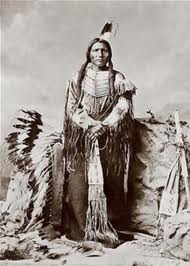
Oglala Chief Crazy Horse

The confrontation came after a series of systematic, murderous raids on the native tribes by the U.S. Army and in particular General Custer, who boasted he would drive the "red devils" from their land and slaughter any that resisted. Finally, humiliated and degraded, Crazy Horse and the other Native American Chiefs consulted the wise chief Sitting Bull [Thathanka Iyotanka], who predicted "the soldiers would fall into their camps like grasshoppers from the sky."

Crazy Horse Thasunke Witko [Lakota translation: "his horse is spirited"]

The Chiefs acknowledged their survival was under threat. Grazing lands were being over-run with white settlers and buffalo were being butchered by profiteering white hunters, who skinned the herds they killed for their hides and left the meat to rot on the plains. Their very existence was being threatened and it was time to come together in an all-out assault for survival against the U.S. Army.

Inspired by Sitting Bull's prediction, The Cheyenne, Lakota, Arapaho and Sioux all gathered at Little Big Horn to plan their next move. Army scouts, tracking their movements, reported the gathering of tribes and the Generals ordered a three-pronged attack on the camp. Custer's Calvary divisions arrived on the scene before dawn, but rather than wait for his re-inforcements as planned, he decided to attack and seize the glorious victory for himself.

Modern battle strategists now say Custer's cowardly assault was ill-conceived. He totally under-estimated the strength of the Indians, thinking they would panic, turn and run. And Custer had refused to take the new, deadly Gatling guns with him, a weapon that would have turned the tide of battle.

At dawn, Custer sent a small party of his best men to a culvert at the back of the camp, where hundreds of horses were being tendered by young Indian boys. The soldiers cut the boy's throats and stampeded the horses into the teepees.

The surprised braves leapt from their beds, gathered their horses and mounted a counter attack driving Custer's retreating soldiers up onto Last Stand Hill. The brutal battle lasted all day and it was here that most of the casualties were incurred - on both sides, until Chief Crazy Horse personally led a charge surrounding the soldiers.

Fanciful images of popular culture: General Custer - the "last man standing"

White historians propagate this myth of "red savages descending on the innocent soldiers who fought bravely until on General Custer stood alone, his golden locks flowing in the setting sun." Nothing could be further from the truth.

The Lakota survivors reported Custer's soldiers threw down their weapons and scattered when they realised they were surrounded. The Cheyenne and Sioux warriors ran them down and despatched them routinely with their lances, coup sticks and quits. The warriors fittingly described it as a "buffalo run." Custer was shot in the head and chest and died on the field with the rest.

Arrogant, self-absorbed and egotistical. "Yellow Hair" General George Armstrong Custer

Unfortunately the U.S. Army reprisals that followed Little Big Horn were severe. The American native revolt led directly to the Wounded Knee Massacre, where the white Cavalry stormed into a native village and killed 146 men, women and children, bringing the Indian wars to an end. Sick of the slaughter and starvation, and nearing extinction the Chiefs decided to surrender and settle their remaining peoples on the white government's Indian reservations.

Crazy Horse and other Oglala chiefs, including He Dog Little Big Man and Iron Crow, arrived at the Red Cloud Agency in Nebraska, May 5th, 1877, They met with First Lieutenant William P. Clark to formally surrender. Crazy Horse lived on the Red Cloud reservation for four months until he was falsely accused of a plot to escape and wreak revenge on the U.S. Cavalry.

Under house arrest, for his own protection, and after being transferred from Red Cloud to the Spotted Tail camp, Crazy Horse and his party finally ended up in Camp Robinson Divisional Headquarters. Chief Crazy Horse and Little Big Man were involved in a scuffle with a post guard who stabbed Crazy Horse with his bayonet. 

The old Chief died later that night and it is thought that his body was sent to Fort Sheridan to be put on public display, but Crazy Horse was secreted away by his parents to be buried at an undisclosed location at Wounded Knee.

Thursday, 21 July 2011

Hangin' With Howard Carter

Sheik Hussein abd-er Rassul in 1999
holding a photo of him, as a boy in 1922, wearing Tutankhamen's Scarab Necklace

On my earliest trips to Egypt, I lived on the West Bank in Luxor and was a regular at the Ramesseum Resthouse, a comfortable lunchtime oasis located directly opposite Rameses 11's Mortuary  Temple, the Ramesseum. At the time, the Resthouse proprietor was an old gentleman Sheik Hussein, an original from the Qurna Village which nestled in the foothills of the Tombs of the Nobles. 

The Sheik was a descendant of the Rassul family and it was his infamous uncles who found the famous cache of Pharaoh's mummies at Deir el-Bahari. In 1874, the three Rassul brothers found the royal mummies of virtually every 18th dynasty pharaoh in a tomb shaft, where they had been hidden from marauding grave-robbers thousands of years before. Their find was only discovered after precious items from the mummies started to turn up on the illegal antiquities market some time after.

For some reason Sheik Hussein took a shine to me and I was invited to stay at his house, meet his family and enjoy many meals and social occasions in their company. I am still good friends with his sons and their families.

Sheik Hussein had a million stories but my favourite was his description of being present at the discovery of Tutankhamen's tomb in the Kings Valley in 1922. As a 12 year old he was working, as a house-boy, in Howard Carter's house, which is located on the entrance road to the Valley and he often told me how Carter would bring pieces home to photograph, in a studio they had set up in the house.

Tutankhamen's Pectoral Scarab Necklace, now in the Cairo Museum collection

This led to to him showing me a prized photo of him wearing one of Tutankhamen's iconic Scarab necklaces. The Sheik had many other stories about Howard Carter and what life was like back then, some more believable than others, but all were very entertaining.

Howard Carter in 1930


Sadly Sheik Hussein passed on eventually taking all those memories with him. When he died the abandoned Carter house had been securely closed for many years and almost in a effort to collaborate his stories I went to the derelict house one evening and persuaded the guardian to let me in for as few minutes. Sure enough it was all there exactly as the Sheik had described. I felt guilty at ever having doubted him.

Not long after, at a New Years Eve function,  I was talking to a Tourism minister and suggested they should restore the Carter house as it was back then and the obvious attraction it would be for tourists. I'm sure I was not the first person to have such an idea, but I took some satisfaction from attending the official opening of the restored Carter Dig House last year.


Carter's Office in his King's Valley Dig House

Of even greater interest was the bedroom quarters of Lord Carnarvon, Carter's benefactor. I can't imagine how the Lord adjusted to such spartan conditions after being accustomed to the grand proportions of Highclere Castle, his magnificent home in Scotland. [recently featured in the television series Downton Abbey.]

Lord Carnarvon's Bedroom in the Carter Dig House

Friday, 8 July 2011

Bolan Boogie

Marc Bolan - Glam Rock Never Looked So Good

Even though he invented the "Glam" genre, Marc Bolan was a lot more than our perception of the typical Glam Rocker. He was a self-made pop icon. He was a superstar with his band T-Rex. Best of all his music is timeless. T-Rex transcends all music genres. T-Rex is still fresh. T-Rex still has grunt.

Marc Bolan [Mark Feld] was born 30th September, 1947 in East London. At the age of 9 he was given a guitar and in 1959 formed a skiffle band called Suzie and the Hula-Hoops, with a female vocalist - 12 year old Helen Shapiro. He left school at 14, claiming they didn't teach him the things he wanted to know. He was signed to a management contract by Allan Warren. Six months later Warren "sold" the contract to property mogul David Kirch for 200 pounds, in lieu of 3 months unpaid rent.

Undeterred by such a inglorious start, Marc bounced around making demos and formed a band called Tyrannosaurus Rex. But it wasn't until 1969 when he was noticed by producer Tony Visconti that it all came together for him. In 1970 he released Ride a White Swan. He expanded his line-up to a quartet and called the band T-Rex, following up with recording songs Hot Love and Get It On, which reached Number 10 in the U.S. charts.

"Bolan likes to rock now. Yes he does yes he does."

In November 1971, T-Rex signed with EMI and recorded Telegram Sam and Metal Guru, both topping the U.K. charts, followed by Children of the Revolution which reached Number Two. Although no T-Rex single ever became a million-seller, in 1972 their record sales accounted for 6% of total British record sales, selling a massive 100,000 records a day.

"Metal Guru has it been
Just like a silver-studded sabre-tooth dream."

Some say Marc Bolan and T-Rex did not reach their full potential. However two of his albums T-Rex The Slider and Bolan Boogie are still regarded as epitomising the "Sound of the Seventies."

And Marc's unique guitar sound was highly admired, imitated and sought after. Ringo Starr asked him to play on his Ringo album and Marc played on Ike and Tina Turner's Nutbush City Limits.

Marc mostly played on Gibson Les Paul guitars and occasionally picked up a black Gibson Flying V and who can forget his Veleno all aluminium guitar, which was in the Hard Rock Cafe Sydney collection and on the wall before the venue closed in 2009.

"What can I do. We just live in a zoo.
All I do is play the spaceball ricochet."

On September 16th, 1977, Marc had dinner at Morton's Club in London with his love Gloria Jones, with who he had a two year old son Rolan. Marc did not drive, so after a few drinks, at about 4am, Gloria and Marc climbed into her purple Mini GT and Gloria drove them home. On the way, travelling on Queens Ride, South London, Gloria lost control in thick fog, the car left the road and hit a tree. The impact was all on the passenger side and Marc was killed. A genius lost.

Marc's funeral was attended by Rod Stewart, Elton John and David Bowie. His ashes were scattered under a bush in the Keats Rose Bed, at Golders Green.

"And when I'm sad
I slide
Watch me now I'm gonna slide."


Friday, 1 July 2011

Sphinx Avenue of the Gods

 Once again basking in the Egyptian sun after 3,000 years buried under the sand

3,500 years ago when the Egyptian city of Luxor was known as Thebes, the female pharaoh of the day, Hapshepsut  [1502-1482 BC] built a ceremonial avenue between the ancient temple complex at Karnak and the now Temple of Luxor. The 18th dynasty Queen Hapshepsut lined the 2,700 metre long avenue with over 600 Sphinx statues on plinths, all with faces fashioned to her likeness.

100 years later, the boy king Tutankhamen, who was renovating the Luxor Temple, continuing the work started by his grand-father Amenhophis 111, also renovated the Sphinx Avenue by paving its way with sparkling white alabaster. Tutankhamen then re-dedicated the Sphinxes and staged another opening ceremony to coincide with the annual Ophet Festival.

In what must have been an amazing spectacle, Tutankhamen and his entourage paraded the full length of the Sphinx Avenue, strewn with garlands of flowers for the occasion.

Twelve dynasties later, Pharaoh Nectanebo 1 rebuilt the Avenue and replaced the sphinxes to carry his likeness. He also added temples and rest stops along the way and re-dedicated the strip with great ceremony.

The Avenue of Sphinxes. Work continues to be ready for October 2011. 

Sadly, however, over the next 2,000 years the Avenue was lost. The Greco-Romans cleared a section of the area, building wine factories and workshops using the paving stones as materials. Then centuries of  encroaching sand gradually buried what was left. Medieval squatters built houses over the top, some using the Sphinx sandstone blocks as foundation stones and streets constructed to criss-cross the area.

Ten years ago the Luxor Governornate embarked on an ambitious and highly controversial plan to convert the city of Luxor into the world's greatest Open Air Museum. Built up areas around all temples and sites were to be cleared and Luxor was to be restored to look like it did in Ancient times.


The plan called for the mass demolition of historically significant 18th and 19th century era residential housing, every major street widened and thousands of people to be compensated and relocated. Entire villages were torn down. People were forced out of houses their descendants had occupied for generations and the compensation paid did not allow them to re-settle into suitable alternate situations.

Excavating the Sphinx Avenue seemed an impossible task as it lay under one of the most densely populated areas. The main road to the airport ran parallel for a distance and more importantly a very old mosque had to be re-located. And the archeologists were not sure what they would find. Fortunately, after the houses were cleared and they sand removed, they discovered the remnants of enough sphinxes to make restoration worthwhile. Some were complete, some sawn into blocks and able to be resurrected, others destroyed with just the plinths remaining.

The end result will be worth it - if you prefer history presented as a "theme park" The local egyptians who paid the price don't think so and neither do the regular visitors to Luxor who liked the "quaint" vibrant village life that gave the city a soul.


The good news is the restored Sphinx Avenue is scheduled to be completed in October this year. An amazing feat and a wonderful sight to see the statues exposed after all this time. I for one cannot wait to make the walk from Luxor to the Karnak in the footsteps of the ancients.